Ione McCall
  • Home
  • Contact
  • Portfolio
    • 3RD YEAR >
      • NORTHERN SODA LABELS
      • PENGUIN DESIGN
      • VENUE REVIVAL
      • PROFESSIONAL PRACTICE
    • 2ND YEAR >
      • COMIC
      • ON LOCATION
      • GIG POSTER
      • 2D ILLUSTRATION
      • 3D ILLUSTRATION
      • EDITH CAVELL ANIMATION
  • Blog
  • FINAL SEMESTER SUBMISSION

RESEARCH BLOG

week 4: The graphic code of comic books

25/2/2020

0 Comments

 
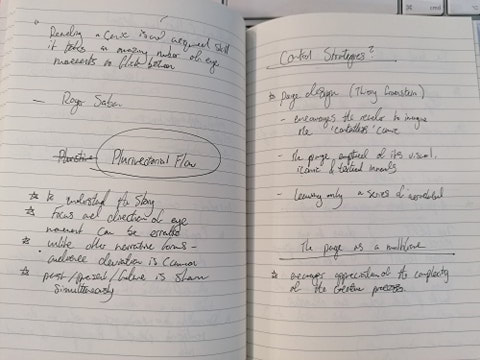
 This week we were looking at the graphic code of comic books and how comic artists use this code, or signs, to create a visual story. This is a code unique to comics which is generally easier to understand, and is understood better by the reader.
Our given task is to look at a comic artists and interpret their work with the learned material above. I've decided to go for Daniel Clowes and his cult comic Ghost World (2000); the story follows two girls (Rebecca and Enid) who are on the cusp on adulthood and start to realise that maybe their friendship isn't as stable as it once was. I've always been a fan of coming-of-age stories, so naturally this is what intrigued me to read the comic. I found it quite surprising that - given the colourful cover - Ghost world is entirely a 3-colour comic (two colours if you discount the white of the paper). I feel like this is maybe meant to represent that, although, your teenage years are supposed to be the kind of rebellious and most colourful years of your life, some aspects of coming into adulthood are actually quite bleak since there's a lot of emotional and difficult times throughout. Clowes' use of black, white, and a pale minty-green make this idea seem all the more valid since there's no vibrancy at all.

The comic mostly follows the 9 panel grid layout with some exceptions of those panels becoming a couple of larger ones, or an interestingly shaped one etc. Page 15 of the book displays this excellently as we see the top row containing the title of the comic which then extends down the lefthand side of the page, setting the scene of the next chapter.
                                                                                                                                                                                           
Picture
Fig 1 - Ghost World (Clowes, 2000, p.15)
Even though this is quite a unique looking panel arrangement, it does follow the standard order of direction for following a comic: eye hits top left of page (which draws our eye down the length of the panel), eye then hits middle of the page (we hit the middle panel searching for the continuation of the story which is above it), and eye then finally follows down to the bottom right of the page where it ends. The pictorial flow of the page is not just dependent on the layout but also the transition from panel to panel. Types of transition (McCloud,1993 p.70-73) are:

​
subject-subject
(same scene/concept, moving character to character or character to object)

moment-moment (panels side by side, moments of time have elapsed)

​action-action(different actions, same scene, some closure ahead)
​
scene-scene
​
(geographic location - notable change of time and/or space, deductive reasoning needed)

​aspect-aspect (same setting, no apparent shift in time, shows different aspects of the same scene)


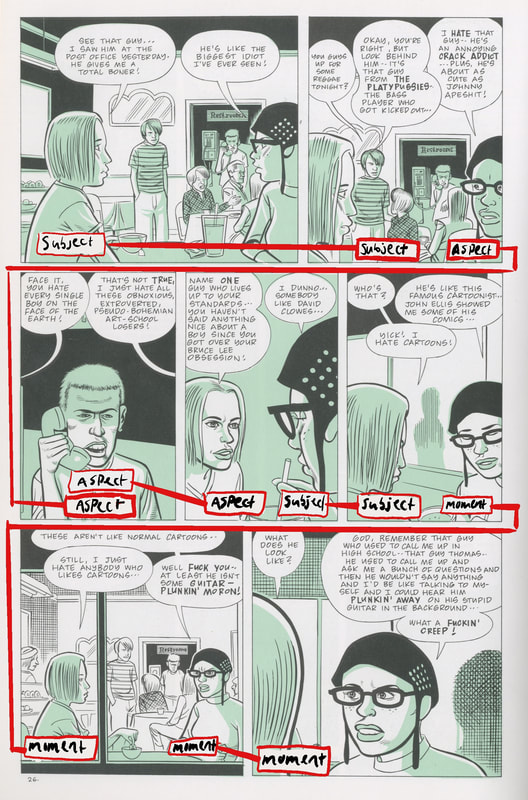
An example of these transitions can be found below on this example of an analysis of page 26, where Rebecca and Enid are discussing love interests.
                          
Picture
Fig 2 - Ghost World (Clowes, 2000, p.26)
The part I find most interesting about this page is that for the aspect-aspect transition, Clowes uses the person of their conversion on the phone to show that the scene is taking place in a public space and there are other people present going about their lives - a different aspect of the scene. It's not just solely about Enid and Rebecca's conversation, but what's going on around them. Comics don't necessarily have to follow a strict plot thats exclusively between two people, or a group of people, or one person - they need to show that there is an atmosphere surrounding the story in order to convey the particular sense of emotion or feeling the author is trying to get at.

Extra reading: analysis of comic book closure, Scott McCloud (2000, p.70-75)
References

Fig 1 - Clowes, D. (2000) Ghost World, Jonathan Cape, Random House, p.15 and p.26
​
McCloud, S. (1993) Understanding Comics. Northampton: Tundra Publishing

​
0 Comments


Leave a Reply.

Site powered by Weebly. Managed by 34SP.com
  • Home
  • Contact
  • Portfolio
    • 3RD YEAR >
      • NORTHERN SODA LABELS
      • PENGUIN DESIGN
      • VENUE REVIVAL
      • PROFESSIONAL PRACTICE
    • 2ND YEAR >
      • COMIC
      • ON LOCATION
      • GIG POSTER
      • 2D ILLUSTRATION
      • 3D ILLUSTRATION
      • EDITH CAVELL ANIMATION
  • Blog
  • FINAL SEMESTER SUBMISSION